

DESIGNED TO ADAPT. BUILT TO PERFORM.
Electric Linear Cylinders for All-Electric Construction Equipment
The actuation your machines need today — and the precision your roadmap requires tomorrow.
When Precision and Autonomy Are the Goal, EMAs Change the Equation
Hydraulic actuation is capable. It can support automation, precision control, and advanced machine features — but doing so requires additional hardware, external sensors, and components with physical tuning limits. When a hydraulic system needs to behave differently, hardware often has to change with it. A valve gets swapped. A fitting gets replaced. The ceiling is defined by what is installed.
EMAs take a different approach. Precision position and velocity sensing are built into the system from day one. Motion profiles, limits, soft start/stop, and coordinated multi-axis behavior are configured and updated in software — with no hardware changes required. There is no physical ceiling on tuning.
This makes EMAs the right choice for compact off-highway equipment where high-precision control and autonomous operation are the goal. For large off-highway equipment where power density and cost are the primary factors, hydraulics remain the appropriate solution. EMAs are not a universal replacement — they are the right tool for a specific and growing set of applications where software-driven precision and autonomy matter most.
Electric Linear Cylinders Built for Heavy Equipment
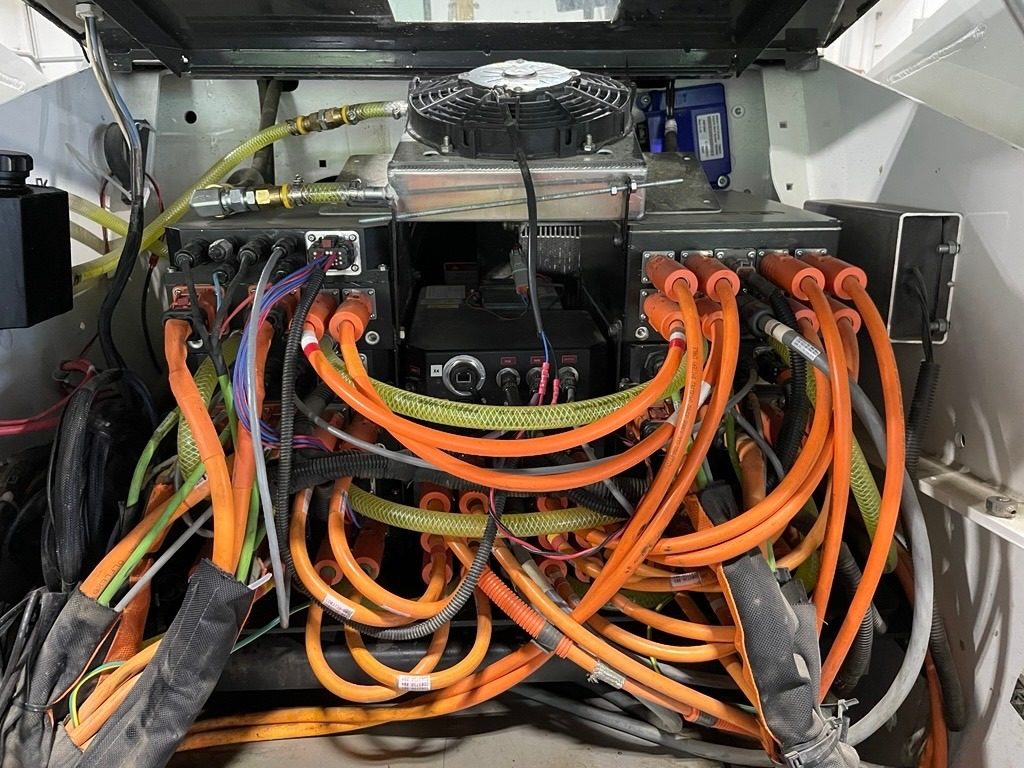
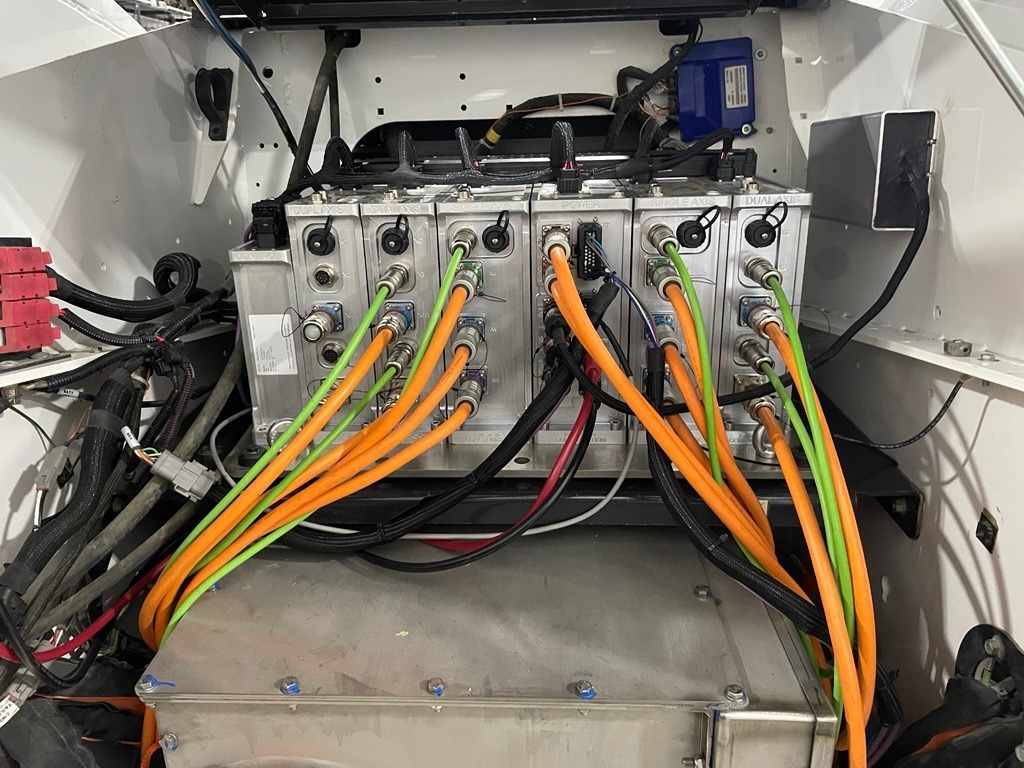
Moog Construction’s electric linear cylinders, also called Electro-Mechanical Actuators (EMA), are purpose-built actuation hardware for all-electric and hybrid off-highway construction vehicles. They convert electrical energy into powerful, precisely controlled linear motion — and they are engineered to match the force and speed demands of the hydraulic cylinders they work alongside or replace.
Each cylinder is built around a precision ball screw and gearbox assembly, driven by an integrated motor and paired with power and signal connectors for straightforward integration into your control architecture. The result is a self-contained, high-force actuator that fits your existing machine architecture and opens the door to a new generation of software-driven features.
These are not off-the-shelf components adapted for construction. They are designed from the ground up for the demanding duty cycles of lift, tilt, boom, and stick actuation in loaders, excavators, and other off-highway machines.
What EMAs Make Possible
Enables Autonomy
Autonomous and semi-autonomous machines require precise, repeatable, software-driven motion. Servomotor-driven EMAs with absolute encoders support coordinated multi-axis moves, adaptive motion profiles, soft start/stop, and position holding — all tunable by software and updatable over the air. The Bobcat T7X is a working example of what this looks like in production. Hydraulics cannot support this level of software integration.
Superior Precision and Advanced Features
Direct position and velocity control with absolute encoders enables micro-positioning and motion repeatability that open-center hydraulic systems cannot achieve. This precision unlocks practical advanced features: auto-weighing, for example, uses bucket force data from the actuator to report payload weight in real time — giving operators a measurement like 1,800 lbs without any additional sensors. These are the kinds of differentiating features that define a product roadmap.
Lower Total Cost of Ownership
The upfront cost of electric linear cylinders is higher than hydraulic cylinders. The lifetime cost is lower. No hydraulic fluid means no oil changes, no hose replacements, no leak-related maintenance, and no contamination risk. Embedded sensors — torque, current, position, temperature — feed diagnostics for predictive maintenance, reducing unplanned downtime. For OEMs thinking in lifecycle terms, the math favors EMAs.
High Force Output — Over 130kN
Our electric linear cylinders deliver peak forces well over 130kN, meeting the demands of heavy work cycles across lift, tilt, boom, and stick applications. For continuous very high force requirements, hybrid architectures combining hydraulic power with EMA control are also a viable path.
Key Performance Specifications:
| General Performance Capabilities | |||
|---|---|---|---|
| Specifications | Series 5 | Series 6 | Series 8 |
| Peak Force (Extend & Retract) |
106 kN (23,830 lbf) |
190 kN (42,710 lbf) |
249 kN (55,980 lbf) |
| No Load Speed mm/s (in/s) |
400 (16) |
500 (20) |
400 (16) |
| A Length mm (in) |
515 + Stroke (20.3 + Stroke) |
508 + Stroke (20 + Stroke) |
732 + Stroke (28.8 + Stroke) |
| B Length mm (in) |
354 mm (13.9) |
388 mm (15.3) |
544 mm (21.4) |
| C Length mm (in) |
162 mm (6.4) |
210 mm (8.3) |
270 mm (10.6) |
| Operating Voltage | 400V – 800V | ||
| Shock and Vibration | 50g, 6g | ||
| Environmental Ratings | IP66 & IP67 (Protected against hose down and temporary immersion) -40°C to +85°C (Ambient temperature) |
||
In-House Design and Manufacturing
Moog brings more than components. We bring a complete development partnership. Our electric linear cylinders are designed and manufactured in-house, giving you direct access to the engineering team behind the product. From early-stage design reviews to field service support, we work alongside your team to integrate actuation that fits your machine, your timeline, and your software architecture.
This means faster design iterations, tighter tolerances, and a single point of accountability from spec sheet to production.
Where Moog Electric Linear Cylinders Perform
Our electric linear cylinders are deployed across a wide range of all-electric and hybrid off-highway applications, including:
- Compact track loaders and wheel loaders (lift and tilt functions)
- Excavators (boom, stick, and bucket)
- Telehandlers
- Specialty construction vehicles on electrification roadmaps
The Bobcat T7X — a fully electric compact track loader — is a production proof point for what electric actuation enables at scale.
Frequently Asked Questions
What is an electric linear cylinder?
An electric linear cylinder, also called an electro-mechanical actuator (EMA), is a device that converts electrical energy into precisely controlled linear mechanical force. It uses a motor, gearbox, and ball screw assembly to produce controlled linear movement, with absolute encoders enabling direct position and velocity feedback. Moog’s electric linear cylinders are designed for the high-force, high-cycle demands of heavy off-highway construction equipment.
Why would an OEM choose EMAs over hydraulics if hydraulics already work?
The reason is not that hydraulics are broken — it is that they impose a ceiling on what machines can do. Advanced autonomy, software-configurable motion profiles, coordinated multi-axis control, and precision features like auto-weighing all require the kind of closed-loop position control that only electric actuation can deliver. If your OEM roadmap includes any of these capabilities, EMAs are a prerequisite, not just an option.
What is auto-weighing, and how do EMAs enable it?
Auto-weighing is the ability to measure payload weight using force data from the actuator itself. Because EMAs provide precise, real-time force feedback through torque and current sensing, the system can calculate the load in the bucket — reporting a figure like 1,800 lbs to the operator — without any additional weighing hardware. This is not possible with standard open-center hydraulic systems.
What force output do Moog's electric linear cylinders produce?
Moog’s electric linear cylinders deliver peak forces well over 130kN, with configurations designed to meet the force and speed demands of standard hydraulic cylinders in heavy off-highway equipment. For continuous very high force requirements, hybrid architectures combining hydraulic power with EMA-based control are also available.
Can Moog's electric linear cylinders be customized for our machine?
Yes. Our in-house design and manufacturing capability means we work directly with OEM teams to configure stroke, gear ratio, rod end type, connector interfaces, and control integration. Motion profiles, limits, and automation behaviors are parametrically tunable and can be updated over the air. We offer application engineering support from early design through production.
Ready to build what's next?
Whether you are early in the design phase or evaluating suppliers for a production program, our team of application engineers can walk you through how AEMS fits your machine architecture and discuss the fastest path from specification to deployment.
Back